The shortest prompt in the collection so far, and the first one that comes with a sequel.
Everything before this has been long — four hundred words in nine paragraphs, or a whole schema with a negative list attached. This one is a single paragraph of about a hundred and thirty words, followed by a second fragment that is barely a sentence.
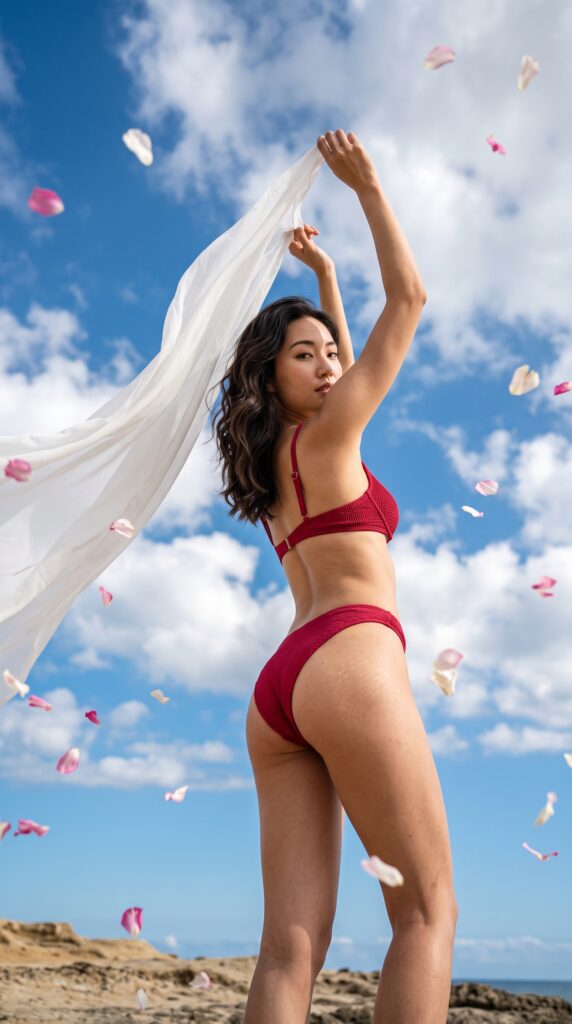
Ultra-realistic professional Sony Alpha photograph, vertical 9:16 editorial fashion shot. A beautiful East Asian woman stands with her back and hips toward the camera in a graceful S-curve pose, arms raised toward the sky, confident and sensual editorial energy. She wears a tasteful designer bikini and a flowing sheer voile scarf that catches the wind. Flower petals drift through the frame. Low-angle epic composition against a vivid blue sky with dramatic clouds, professional studio-quality lighting on skin with natural texture and pores, photoreal human skin, not AI-looking. If her face is visible glancing over her shoulder, natural East Asian facial features, refined bone structure, straight to softly wavy dark hair typical of East Asian beauty. Shot on Sony FE lens, shallow depth, crisp detail, Vogue-style swim editorial, hyperreal.

Same woman, sky, flowers, petals. Standing back pose with Dutch tilt camera angle, dynamic editorial energy. Ultra-low perspective. Ruby-red bikini and sheer white voile contrast. Medium-full shot, cinematic diagonal composition, professional HDR.
That second block is the interesting half. It is not a prompt in its own right — it opens with Same woman, sky, flowers, petals and simply assumes everything the first one established. On its own it would produce nothing coherent. It is a follow-up turn in a conversation, written to be sent after the first, and it only specifies what changes: the camera tilts, the perspective drops further, and the bikini becomes ruby red against white voile.
That distinction — editing rather than describing — turns out to matter for a collection like this one. A prompt written as a follow-up cannot be picked up and reused, because half of what it means lives in the message before it. Saved on its own it looks complete and quietly is not. It is the prompt equivalent of a patch file with no source tree.
The specification style is different again from anything else here. Where earlier prompts described the subject in anatomical detail, this one mostly names equipment and genre: Sony Alpha, Sony FE lens, shallow depth, professional HDR, Vogue-style swim editorial, Dutch tilt. None of that describes what is in the frame. It is all borrowed authority — invoking a camera body and a magazine and trusting the model to have absorbed what pictures made that way look like. Given how much of an image model’s training set is captioned exactly that way, it is probably the highest-leverage sentence per word in this whole collection.
And there is one clause doing something genuinely clever: photoreal human skin, not AI-looking. Every other prompt here spends a paragraph describing pores and grain and highlights in order to escape the plastic-skin default. This one just names the failure state directly and asks for its opposite. Shorter, and on this evidence no less effective.
The hedge is worth noticing too. If her face is visible glancing over her shoulder — the prompt does not know its own composition. It has handed the framing decision to the model and written a conditional to cover either outcome. That is a slightly unusual thing to find in a prompt, and it is honest about where the control actually stops.
The numbers it asked for, it got. Vertical 9:16 came back as 1536×2752 — a ratio of 0.558 against 9:16’s 0.5625, which is as close as you can land on those pixel counts. The petals, the voile, the raised arms, the low angle and the over-the-shoulder glance are all there as written.
The one instruction that did not survive is the Dutch tilt in the second block, and the reason is the prompt’s own fault rather than the model’s. A Dutch tilt is a cant relative to the horizon — it only reads as one because you can see level and the frame is not. This composition is an ultra-low angle into open sky with the horizon almost entirely removed, which is also what the prompt asked for. Having deleted the reference, there was nothing left to tilt against. Two instructions, and the first one quietly made the second one unachievable.