The third prompt in the collection, and the first one whose output is not meant to be looked at.
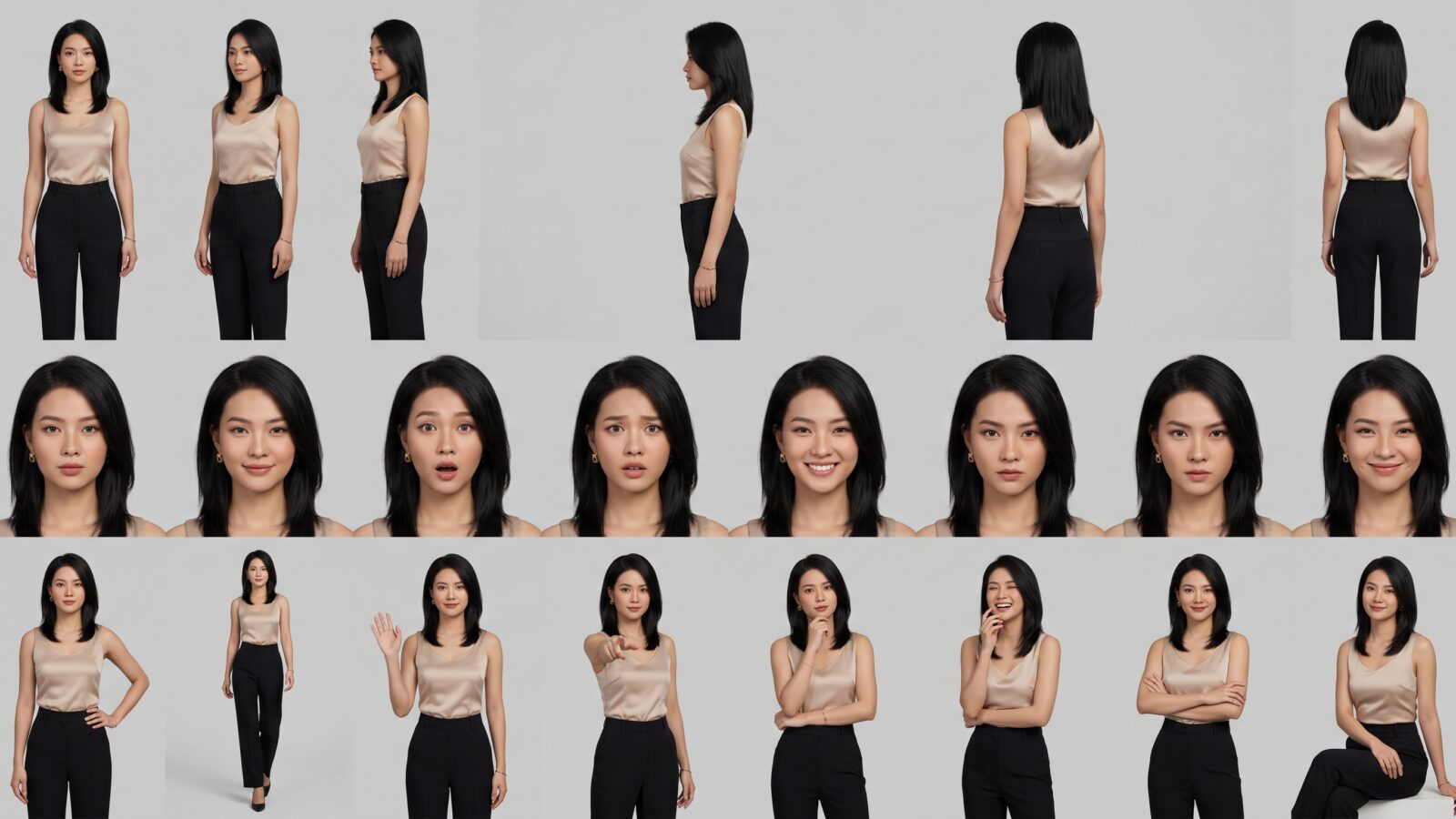
The first and second were prompts for a photograph — you run them, you get a picture, the picture is the point. This one produces a character sheet: twenty-one panels of the same invented woman on a grey studio background, five body angles across the top, eight expressions through the middle, eight poses along the bottom. It is not a picture. It is a reference asset, built to be fed into a video generator so that whatever gets made next has one consistent person in it.
Create a professional character sheet for one consistent realistic Vietnamese woman, designed as a reference image for AI video generation.

Character name: Linh Anh

Character profile:

A beautiful 25-year-old Vietnamese woman with a naturally elegant and attractive appearance. She has a slim hourglass body shape, graceful posture, warm light-medium Vietnamese skin tone, soft oval face, delicate facial features, expressive almond-shaped dark brown eyes, natural full lips, straight black shoulder-length hair with soft layered styling, and a confident feminine aura. Her beauty should feel realistic, modern, cinematic, and authentic, not artificial or doll-like.

Fashion and styling:

She wears a tasteful modern outfit that looks stylish, feminine, and subtly sexy without being explicit: a fitted satin champagne-beige sleeveless top, high-waisted black tailored trousers, elegant small gold earrings, a thin bracelet, and natural glossy makeup. The outfit should emphasize elegance, confidence, and mature beauty, not nudity or overly revealing clothing.

Core visual identity:

The character must remain perfectly consistent across all panels. Keep the same face shape, eye design, nose shape, lips, hairstyle, skin tone, body proportions, outfit, accessories, makeup style, and overall silhouette. All panels must look like the exact same woman from different angles and with different expressions.

Character sheet layout:

A clean professional character reference sheet on a neutral light gray studio background, arranged in a clear grid layout. Full-body views on the top row, facial expressions in the middle row, and gesture / pose references on the bottom row.

Full-body angle references:

Front view, neutral standing pose
3/4 front view, slightly turned toward camera
Side view, relaxed posture
3/4 back view, showing hairstyle and outfit silhouette
Back view, clean full-body reference

Facial expression close-ups:

Neutral calm expression
Gentle confident smile
Surprised expression
Slightly confused expression
Happy bright smile
Thoughtful serious expression
Determined focused expression
Playful charming expression

Gesture and pose references:

Standing relaxed with one hand on waist
Walking pose with confident runway-like movement
Waving gently
Pointing forward as if presenting something
Thinking pose with one hand near chin
Laughing naturally
Confident pose with arms crossed
Casual seated pose, elegant and relaxed

Visual style:

Realistic human character design, cinematic portrait photography quality, high-fashion commercial look, natural Vietnamese beauty, realistic skin texture, soft studio lighting, subtle shadows, high detail, clean composition, professional model reference sheet, consistent face identity, consistent body proportions.

Camera and rendering:

Sharp focus, 50mm portrait lens look for close-ups, full-body studio photography for angle references, soft beauty lighting, natural color grading, realistic fabric texture, realistic hair strands, clear readable layout, no dramatic background, no extra props.

Important consistency rules:

Do not change her face, hairstyle, body shape, skin tone, outfit, accessories, makeup, age, or art style between panels. Every panel must show the exact same woman, only changing angle, pose, or expression.

Negative prompt:

No nudity, no lingerie, no explicit sexual pose, no overly revealing clothes, no different outfits, no inconsistent face, no changing hairstyle, no changing body proportions, no extra characters, no distorted hands, no extra fingers, no duplicate faces, no heavy plastic skin, no anime style, no cartoon style, no doll-like face, no old age, no childlike appearance, no background scene, no messy layout, no text labels blocking the character.
She has a name — Linh Anh — and that is the first clue about what this is actually for. Nobody names a photograph.
Look at where the words go and the subject is obvious: consistency. There is a section headed Core visual identity, a second headed Important consistency rules that mostly restates it, and then a negative prompt longer than either of the first two prompts in this collection were in full — no inconsistent face, no changing hairstyle, no changing body proportions, no duplicate faces. Roughly a third of this prompt is one instruction said four different ways: keep her the same.
Which tells you what the hard problem is. Nobody writes four hundred words defending against a failure that does not happen.
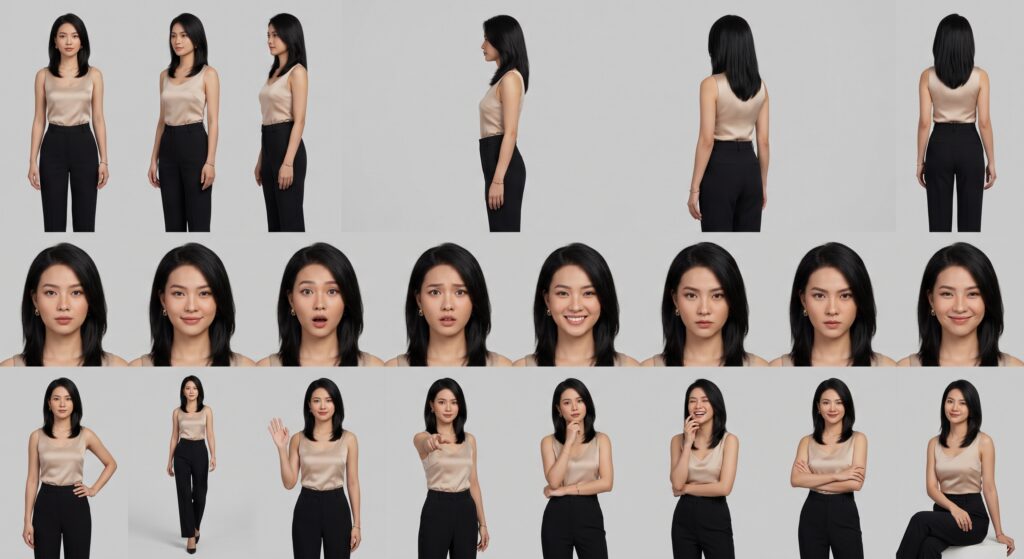
And it half works. The outfit holds across all twenty-one panels: the champagne satin top, the black high-waisted trousers, the small gold earrings, the thin bracelet, consistent down to the sheen on the fabric. The expression row delivers exactly the eight expressions asked for, in the order asked for. The pose row delivers exactly the eight poses, in order. For a single generation that is a lot of instruction followed correctly.
What drifts is her hair — which is precisely the thing the prompt forbids twice. It is specified as straight black shoulder-length, and in the close-up row it is shoulder-length. In the rear and three-quarter-back views it falls well past the shoulder blades. Naming a failure in the negative prompt does not prevent the failure. It only records that the author already thought it was likely.
The layout is the other soft spot. The top row asked for five full-body angles in a clean grid and came back ragged, with a blank panel sitting in the middle of the row for no reason at all. Clear readable layout and clean composition are both in there; the model read them as mood rather than as instruction. Composition is not something you get by asking politely.
One piece of housekeeping for this collection going forward. This one came out of Gemini — the filename says so, which is more than I can tell you about the first two. The prompt above is not portable, because half of what makes it work is how one specific model reads one specific phrase. A library of prompts with no record of what produced them is a library of guesses, so I will be noting the model from here on.