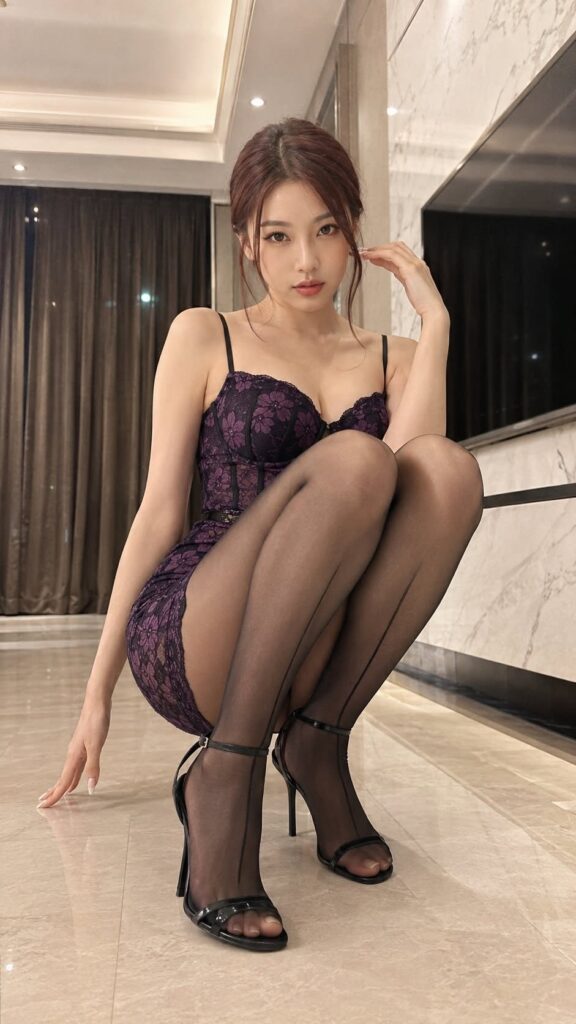
A crouching full-body portrait in a night apartment. Almost everything landed — and the negatives tell you what went wrong the time before.
What it got: essentially all of it. Dark-purple floral lace corset dress with black structured panels and thin straps, sheer black back-seam stockings, black open-toe heels with delicate ankle straps, a low updo with a centre part and two loose strands. The pose is reproduced almost line by line: knees up to the chest, thighs together and angled to camera, one bare hand flat on the floor for balance, the other bent beside her face. Camera near floor level, legs forward in the frame, face and full body still visible. Cream marble, dark floor-to-ceiling curtains, a big black television, warm recessed ceiling lights.
The negatives are the interesting half, because of what they imply. Read them on their own: no scarf, no lace collar, no cape, no choker. She has no horns or head accessories. Her hands are completely bare. Nobody writes “no horns” from a blank page. Every one of those is a correction — this prompt is a later draft, and the list is a record of what earlier runs kept adding. The neck and shoulders got dressed up when nothing asked them to, and something put horns on her.
Which makes it a useful thing to keep. A prompt that has been through a few rounds carries its own bug list at the bottom, and that list is often more informative than the description above it. It tells you where this kind of image drifts: models like filling an empty neckline, and they like adding a silhouette to a head. If you write a new prompt in the same genre, those two are worth pre-empting even if your first run has not made the mistake yet.
One image only, so nothing to say about what holds across runs.